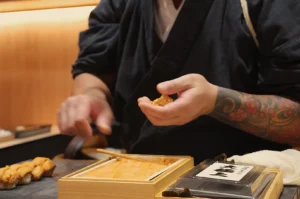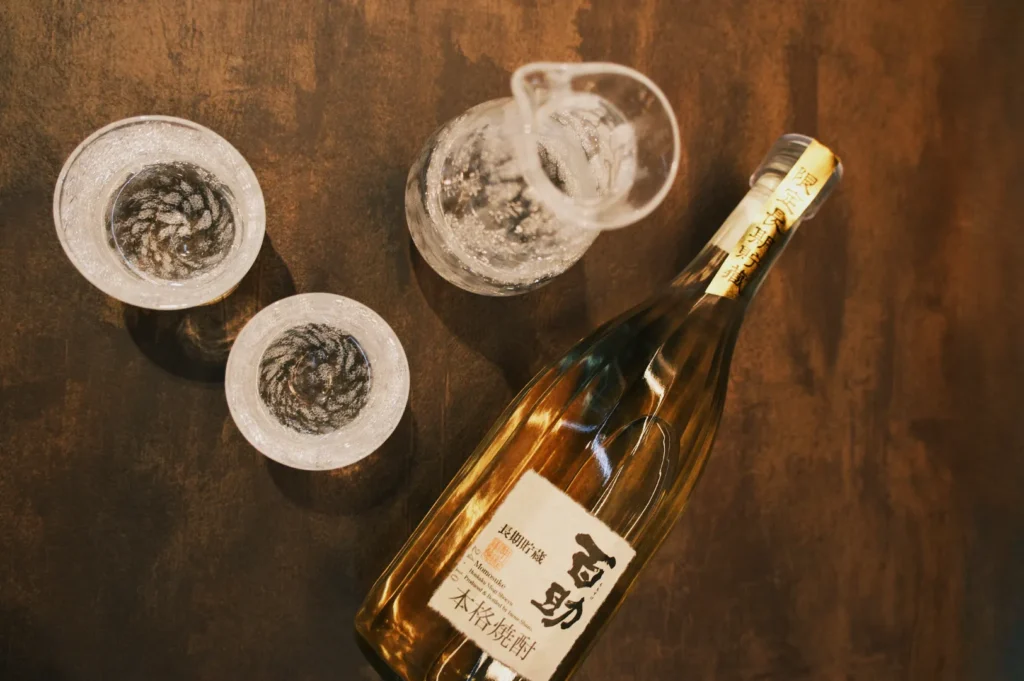
Drinking sake with a meal is simple. Pouring a glass, taking a bite, letting the two meet by chance. Sake pairing within omakase is something else entirely. Here, each pour is chosen to sit beside a single piece, in a single moment, before the next arrives. The word omakase means “I leave it to you.” It is a chef-driven progression, where every course builds on the one before. A thoughtful sake pairing follows that same deliberate arc. Not one drink for the whole meal, but a quiet series of decisions that move with the food.
The Science Beneath the Sensory
Good pairing works on two levels at once. One is measurable. One is felt.
The measurable part begins with umami. Sake carries glutamate, roughly 100 to 250 mg per 100mL in many Junmai styles. Seafood carries inosinate. When the two meet on the tongue, they act on the T1R1/T1R3 receptors together, amplifying the sense of umami by seven to eight times. Neither element does this alone. It is the meeting that matters.
There is another quiet advantage. Sake contains virtually no iron or sulphur dioxide. These are the compounds that can turn wine sharp and metallic against raw fish, drawing out a fishy off-note. Without them, sake sits closer to the sea, rarely fighting it.
The sensory part is harder to chart. It lives in acidity, body, aroma, sweetness, and temperature, and in how all of these settle against a particular piece of fish, prepared a particular way.
What a Pairing Must Account For
The Seafood Itself
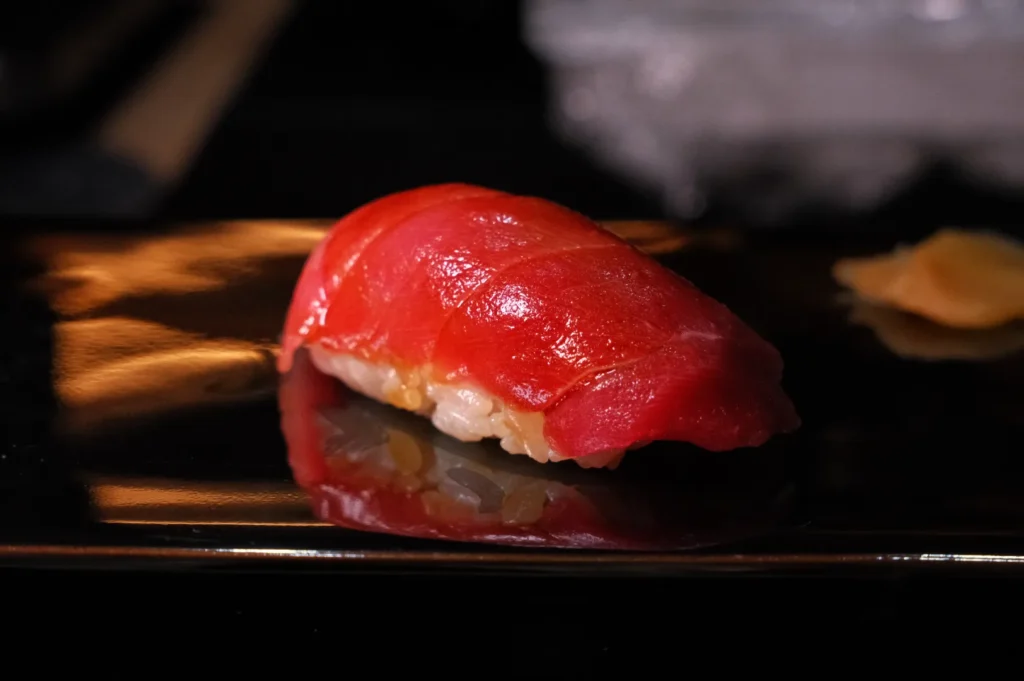
Fish is not one thing. A delicate white-fleshed hirame (flounder) or madai, the Japanese red sea bream, often served early in an omakase, carries little oil and a soft, clean umami. Yellowtail sits in the middle, fuller and more oily. Then there is otoro, the fattiest cut of tuna, richer than chutoro and far richer than lean akami. That fat coats the palate. It asks for a sake with more body to meet it, something that can stand beside the weight rather than disappear under it.
The Preparation
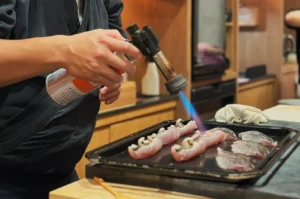
The same fish changes with the hand that shapes it. Raw sashimi is one profile. A light sear over binchotan brings smoke and softened fat. Grilling deepens it further. A vinegared cure sharpens and brightens. Each preparation shifts texture, aroma, and intensity, and the pairing shifts with it.
The Seasoning
The fish is rarely alone. Soy sauce brings saltiness. Sushi rice brings a gentle acidity. Wasabi brings heat. A squeeze of citrus brings its own brightness. Any of these can alter a pairing as much as the seafood does. This is why the complete bite matters more than the fish in isolation.
Reading the Sake
To pair well, it helps to understand what you are pouring. A few characteristics guide the way:
- SMV (sake meter value) measures specific gravity, not direct sweetness. A number alone will not tell you how sweet a sake tastes.
- Acidity shapes the perception of dryness, often more than SMV does.
- Amino acid content influences richness and savoury depth.
- Aromatic profile ranges from quiet and clean to floral and fruit-forward.
- Body determines whether a sake feels light or full across the palate.
A word of caution. A category label such as “Junmai Ginjo” does not promise one universal flavour. Two bottles under the same name can taste worlds apart, shaped by rice, water, and the brewer’s own hand. The classifications of Japanese sake offer a useful map, but never the full terrain.
Temperature Changes Everything
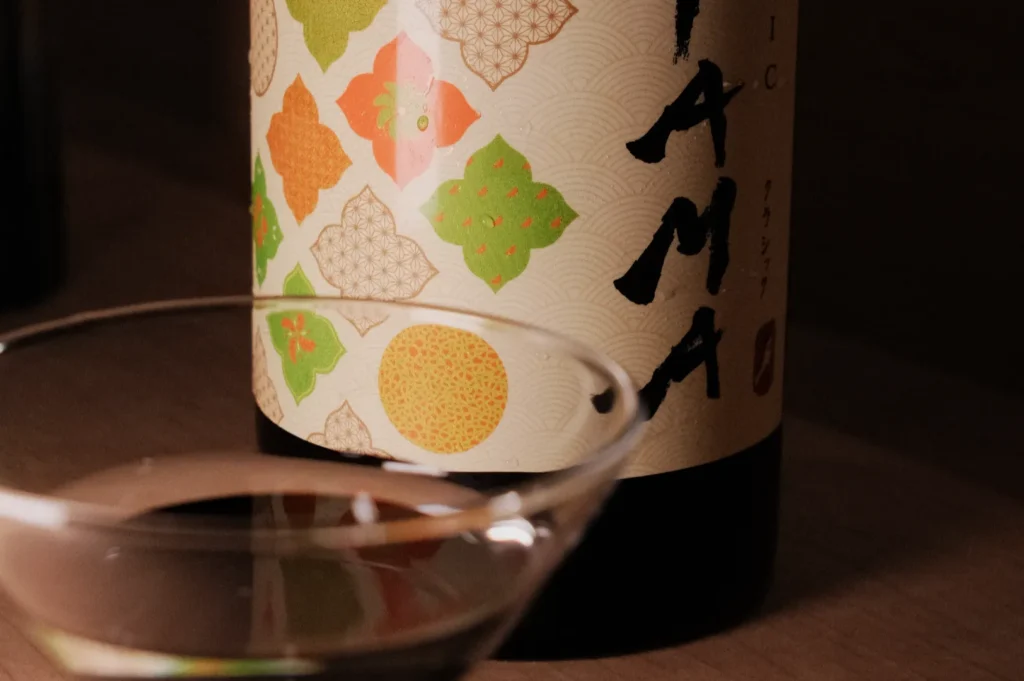
Serving temperature is not a detail. It touches every sensory dimension: aroma, sweetness, umami, acidity, texture, and the warmth of alcohol.
Cold sake tends to suppress sweetness and umami while preserving delicate, volatile aromas. It can bring clarity and precision, well suited to lighter fish.
Warm sake does the reverse. It amplifies umami and body, drawing out savoury depth, a natural partner for richer, fattier cuts. But warmth carries a risk. The fragile ginjo-ka, the fruity, floral aroma of premium aromatic styles, can be lost entirely when heated. What you gain in body, you may lose in scent.
A Practical Framework
Three ideas guide most thoughtful pairing:
- Match intensity to intensity. A delicate white fish wants a delicate, precise sake. A fatty cut wants fuller body. Let neither overwhelm the other.
- Consider the complete bite. Seasoned rice, fish, soy sauce, and wasabi arrive together. Pair with the whole, not the fish alone.
- Build progression. Move from lighter to richer as the meal unfolds, so the palate deepens rather than tires.
This interplay between course design and sake selection is felt most clearly in a small room. Sushi Masa by Ki-setsu holds only eight seats, at 5 Koek Road, #06-03 Cuppage Plaza, Singapore 228796, near Orchard Road. In such a setting, each pour can follow each piece with intention, guided by the chef and shaped by the evening’s fish.
No Single Perfect Pour
There is no universally perfect pairing. Personal preference matters, and what sings for one guest may sit quietly for another. Fish changes with the season, its fat and flavour shifting month to month. And every brewery carries its own style, so no two sake behave exactly alike.
Pairing, then, is not a formula. It is attention. A careful reading of fish, preparation, seasoning, and sake, held together in a single moment, and left, gently, in trusted hands.