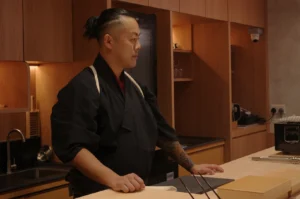
Bangkok holds two versions of itself on the same map. One moves quickly, at street level, where the food arrives without ceremony. The other slows down, dressed in white linen and quiet rooms. In this episode of Behind the Counter, Chef Masa steps into both, first at SABX2, also known as SAB Koon Song, and then at Blue Elephant Restaurant.
He does not arrive to compare or to judge. He arrives to watch, to taste, and to notice how differently two kitchens can speak the same language.
At SABX2: Bold Flavour, No Ceremony

SABX2 offers the kind of dining that many locals know well. It is direct, unhurried in spirit yet fast in service, built around flavour rather than presentation.
Here, the smaller details catch his attention. He tries the peanuts and pauses over them, noting the texture with real care. “Very good. Not too crispy. Perfect.” It is a small thing, easily overlooked, but he lingers on it the way a cook does when something has been prepared with intention.
That is what SABX2 reveals about him. He reads a dish through its texture and balance, whether the setting is grand or plain. A good detail earns his attention regardless of the room it arrives in.
At Blue Elephant: A More Formal Room

Blue Elephant offers a different rhythm. The dining is composed, the setting more refined, the plates arranged with visible thought. Where SABX2 leans on immediacy, Blue Elephant leans on presentation and structure.
Chef Masa notices the contrast. One dish draws his eye for its contrasting textures, described simply as “really crispy and moist and soft” across a single bite. He responds to how the kitchen has layered sensations, the way a formal Thai table often does.
Neither place tries to be the other. And that, quietly, is the point.
Two Approaches, One Curious Eye

What stays with him across the two visits is not a preference. It is the reminder that inspiration does not belong to one type of restaurant. An accessible local establishment can teach as much as a formal dining room, sometimes more.
He watches how each kitchen handles balance, heat, and texture. He observes their hospitality, their pacing, their choices. None of it will appear on the counter at Sushi Masa. That is not the purpose. The purpose is to stay observant, to keep the eye open, to remain a student of how food is made everywhere.
Behind the Counter exists to document these moments. Not the omakase itself, but the meals and encounters that shape the person who returns to it. Each visit adds something to how Chef Masa sees his craft, quietly and over time.