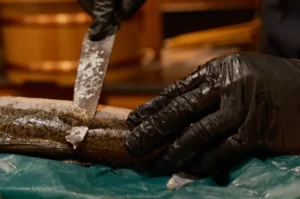
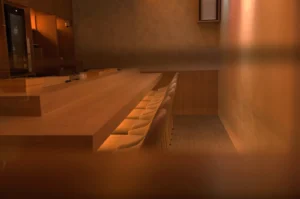
Behind an unassuming door on the sixth floor of Cuppage Plaza, near Orchard Road, the noise of the city softens. Inside, there is a counter. Eight seats. A single sweep of hinoki wood. And behind it, Chef Masa or Nakano Masayuki, born in Tokyo, at work in the quiet.
This is Sushi Masa by Ki-Setsu. A Japanese omakase restaurant, seafood-focused, seasonal, open only for dinner. The eight seats are not a limitation. They are the point.
Why Eight Seats

It would be easy to read “eight seats” as a number. A capacity. A line on a floor plan.
But sit down, and you begin to understand it differently.
At a larger restaurant, the kitchen works behind walls. Plates arrive when they arrive. The distance between the person who cooks and the person who eats is measured in doors and corridors and the timing of service staff.
Here, that distance disappears. Chef Masa stands an arm’s length away. He watches how you eat. He sees whether you linger over a slice of sashimi or reach quickly for the next. He notices when a table has slowed to talk, and when it is ready to move on.
Eight seats let him hold the whole room in view. Nothing is lost to the edges.
The Rhythm of a Room

An omakase meal is not a set of dishes delivered on a schedule. It is a sequence, paced to the people in front of it.
With a small counter, Chef Masa can read that pace. A piece of nigiri is shaped and set down at the moment it should be eaten. Not before, when the rice would cool. Not after, when the guest is waiting. The temperature of the rice, the warmth still held in a lightly seared cut of fish, the crispness of fresh nori: these things depend on timing measured in seconds.
That kind of precision is difficult to sustain across many tables. Across eight seats, it becomes possible. It becomes the standard.
Course by course, the meal moves at the speed of the room. A cool, clean slice of sashimi. Then something warm and simmered. Then a hand-roll, passed across the counter to be eaten straight away, while the seaweed still snaps.
Nothing rushes. Nothing lags.
A Conversation, Not a Performance

There is a temptation, in fine dining, to treat the open kitchen as theatre. To make the chef a performer and the guest an audience.
That is not what happens here.
The counter at Sushi Masa is closer to a conversation. Chef Masa might explain where a fish came from, or when it arrived. He might adjust a piece based on what he has already served you. Omakase, meaning “I leave it up to you,” only works when the chef can actually respond to the person in front of him.
Eight seats make that response direct. You are not one of forty. You are one of a handful, and the meal is shaped, in small ways, around you and the seven others beside you.
There is no spectacle in this. Only presence. The click of the knife. A short exchange. A plate set down, and then quiet again.
Seafood, and the Season

What arrives at the counter changes through the year. This is the principle of shun. Ingredients served at their peak, when they are meant to be eaten.
Early summer might bring aji, horse mackerel, bright and firm. Winter might bring buri, yellowtail heavy with fat. Nodoguro, blackthroat seaperch, lightly grilled to draw out its oils. Uni, sea urchin, folded into a hand-roll.
Because the menu follows the season rather than a fixed list, the small counter matters here too. Chef Masa is not repeating the same dishes hundreds of times a night. He is working with what the sea offered that week, adjusting as he goes, giving each ingredient the attention it needs.
Dinner only. No lunch service to blur the focus. The evening is given entirely to this.
More Than a Seating Number

Return to those eight seats one last time.
They are not there to signal exclusivity, or to make a table hard to reach. They are there because the omakase Chef Masa serves cannot be delivered any other way. The observation, the timing, the direct exchange, the calm. These depend on a room small enough to hold in a single gaze.
A larger counter would be a different restaurant. A different kind of meal.
The eight seats are the form the experience takes. Remove them, and you remove the thing itself.
So when you sit down at Sushi Masa, you are not choosing from a menu. You are choosing to trust the chef, the season, and the quiet choreography that unfolds across a single length of wood.
Eight seats. One evening. And the sense, rare and welcome, that you have been seen.