Acidity is easy to overlook in sake. It sits quietly beneath sweetness and aroma, yet it does some of the most useful work at the table. When you pair sake with seafood, acidity is often the reason a bite feels clean rather than heavy, and the reason the next piece of fish registers as clearly as the first.
To understand pairing, it helps to start with what acidity actually is, and how it behaves.
What San-do Measures
In sake, acidity is expressed as San-do. The sake San-do measurement refers to the total organic acid content, chiefly lactic acid, succinic acid, and malic acid. It is not a single flavour, but a blend, and each acid contributes something slightly different.
Sake is generally lower in acidity than wine. Even so, this moderate acidity plays a functional role. Organic acids bind to free fatty acids on the palate, lifting oil residues and refreshing the mouth. This is the mechanism behind palate cleansing sake, the sense that the mouth feels reset between bites.
Succinic acid deserves a note of its own. It is found abundantly in both shellfish and sake, and it carries a distinctive umami-sourness. That shared quality adds to the sensation the Japanese call koku, a feeling of richness or body. When a scallop meets a sake with gentle succinic character, the two can echo one another.
A quick point of honesty: San-do is a useful guide, but it is not the same as pH balance, and it does not tell you everything about how a sake will taste. Numbers describe tendencies. The palate makes the final decision.
Acidity Ranges by Style
Different styles of sake tend to fall within broad acidity ranges. Treat these as tendencies, not rules, as individual bottles vary widely, even within one category.
- Ginjo and Daiginjo: roughly 1.0–1.3. Often cleaner, lighter, more delicate.
- Junmai: roughly 1.3–1.6. Fuller, with more structure.
- Kimoto and Yamahai: roughly 1.4–1.8 and above. The Kimoto Yamahai acidity comes from traditional brewing methods that encourage natural lactic acid development, producing depth and a firmer backbone.
No two sakes within a style are identical. A Junmai from one brewery may feel brighter than a Junmai from another. The ranges simply give you a starting point.
For the wider framework that acidity fits within, sweetness, body, aroma, and temperature working together, our sake pairing guide offers a fuller picture.
Matching Acidity to Fat and Texture
Here is where acidity earns its place. Seafood texture pairing often comes down to a simple question: how much fat and oil does the fish carry?
Higher-acid sakes, San-do above 1.5, tend to suit richer seafood. The way acidity cuts fish oils makes it a natural partner for the marbled fat of otoro, the oily richness of salmon, and the frying-oil residue left by tempura. The acid lifts that weight from the palate, so richness reads as pleasure rather than heaviness. This is the heart of fatty fish pairing.
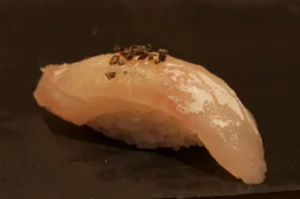
Lower-acid sakes, San-do below 1.3, tend to suit delicate seafood. White fish such as hirame and tai carry subtle, quiet flavours that aggressive acidity could overpower. Raw oysters ask for restraint too, where preserving their briny minerality matters more than cutting through fat.
Notice the same acidity level can behave differently depending on the fish. A sharp sake that flatters otoro may overwhelm tai. Fat invites acidity; delicacy asks it to step back. For a closer look at specific levels matched to particular varieties, see our notes on sake acidity with Japanese seafood.
Preparation shifts things as well. A fish that is seared, cured, or dressed with soy behaves differently from the same fish served plain. Seasoning and technique are part of the pairing, not a footnote to it.
How Acidity Interacts with Sweetness and Temperature
Acidity never works alone. Two interactions matter most.
First, the acidity–SMV relationship. Sake Meter Value (SMV) suggests how dry or sweet a sake should taste, but acidity bends that reading. A higher level of acidity can make a sweet-tasting sake seem drier than its SMV alone would suggest. Two bottles with the same SMV can feel quite different once acidity enters.
Second, temperature. Cold enhances the sharp, crisp sensation of acidity, while warmth softens it. Importantly, the actual acidity does not change, only your perception of it. The same sake, served chilled or gently warmed, can feel like two different partners for the same fish.
There is one more quiet function. Acidity promotes salivation, and the lighter-quality saliva it produces rinses the palate between bites. Across a long meal, this matters. Managing omakase acidity balance is really about managing palate fatigue, keeping the mouth fresh so the tenth piece lands as clearly as the first.
Acidity at the Counter
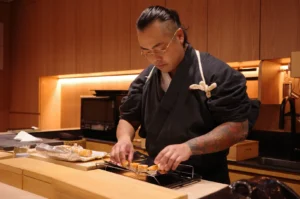
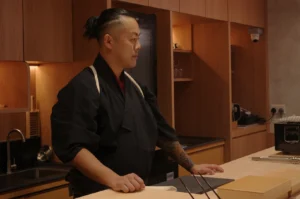
At Sushi Masa by Ki-setsu, an intimate eight-seat omakase counter at 5 Koek Road, #06-03 Cuppage Plaza, Singapore 228796, near Orchard Road, this idea takes on a practical shape. Guests can feel how acidity in sake resets the palate between pieces of nigiri, so each bite registers on its own terms.
Seated at the counter, you notice the rhythm. A rich piece, a considered sip, a clean mouth, the next piece. Nothing rushed. To understand how this unfolds course by course, spend a moment with Chef Masa at Sushi Masa.
One Dimension Among Many
Acidity is a powerful tool, but it is only one dimension of pairing. Sweetness, umami, body, aroma, and temperature all shape the final result, and they rarely act in isolation.
Personal preference remains significant too. What refreshes one palate may feel sharp to another. Preparation, seasoning, and serving temperature all move the outcome. No single pairing is universally perfect, and that openness is part of the pleasure.
Understand acidity, and you gain a reliable way to read a pairing. Hold it lightly, and you leave room for the rest of the table to speak.