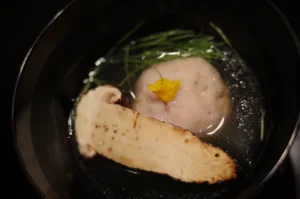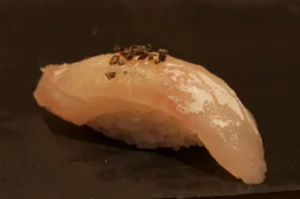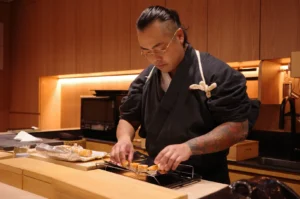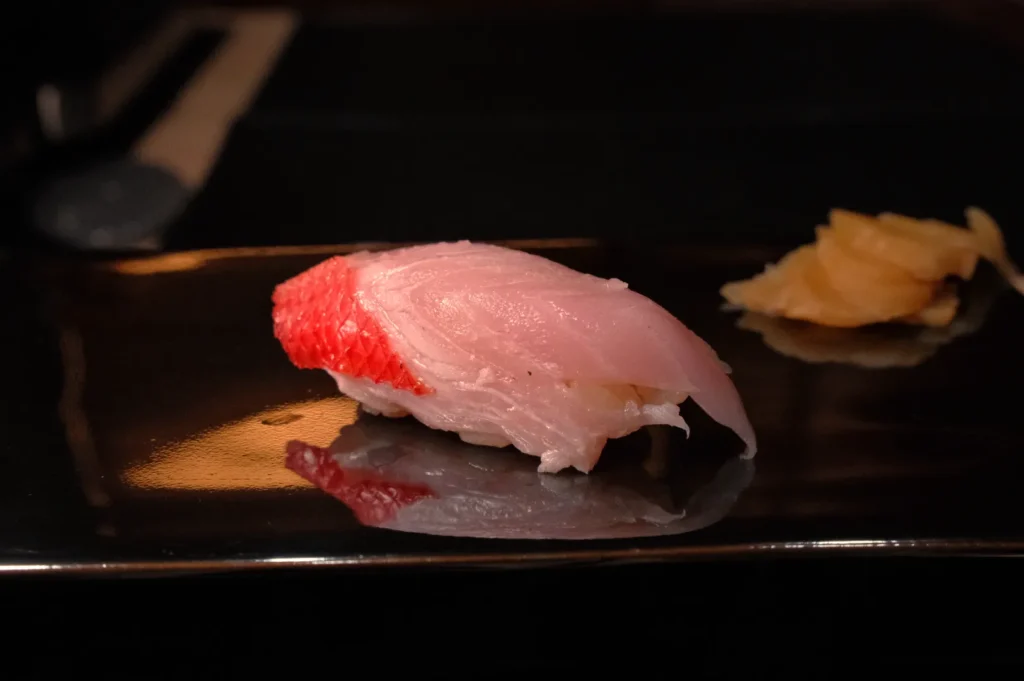
At the counter, a slice of tuna arrives. Beside it, a small cup of sake, poured with care.
A single bite. A sip. Something shifts.
The fish tastes deeper. Rounder. More savoury than the moment before.
This is not chance. It is chemistry, quiet, precise, and centuries in the making.
The Fifth Taste
For a long time, we spoke of four tastes: sweet, sour, salty, bitter. Then came a fifth.
In 1908, Japanese chemist Dr. Kikunae Ikeda studied a bowl of kombu dashi, the humble kelp broth at the heart of Japanese cuisine. He wanted to know why it tasted the way it did. Not sweet. Not salty. Something else.
He isolated glutamic acid from the kelp and gave the sensation a name: Savoury. Full. Lingering.umami.
That single moment of kombu dashi science gave us a word for a flavour cooks had chased for generations without naming it.
How Your Tongue Reads Umami
Umami has its own receptor. On the surface of your taste cells sits the T1R1/T1R3 heterodimer, a G protein-coupled receptor. Think of it as a lock built for two keys.
The first key is glutamate. When it binds deep within the T1R1 receptor, you sense umami.
The second key is inosinate (IMP). It settles into a nearby site. On its own, it does little. But when both bind together, the inosinate holds the glutamate in place. It stabilises the connection. The signal grows stronger, and it lasts longer.
This is the heart of glutamate-inosinate interaction. Two compounds, working as one.
The Multiplier Effect
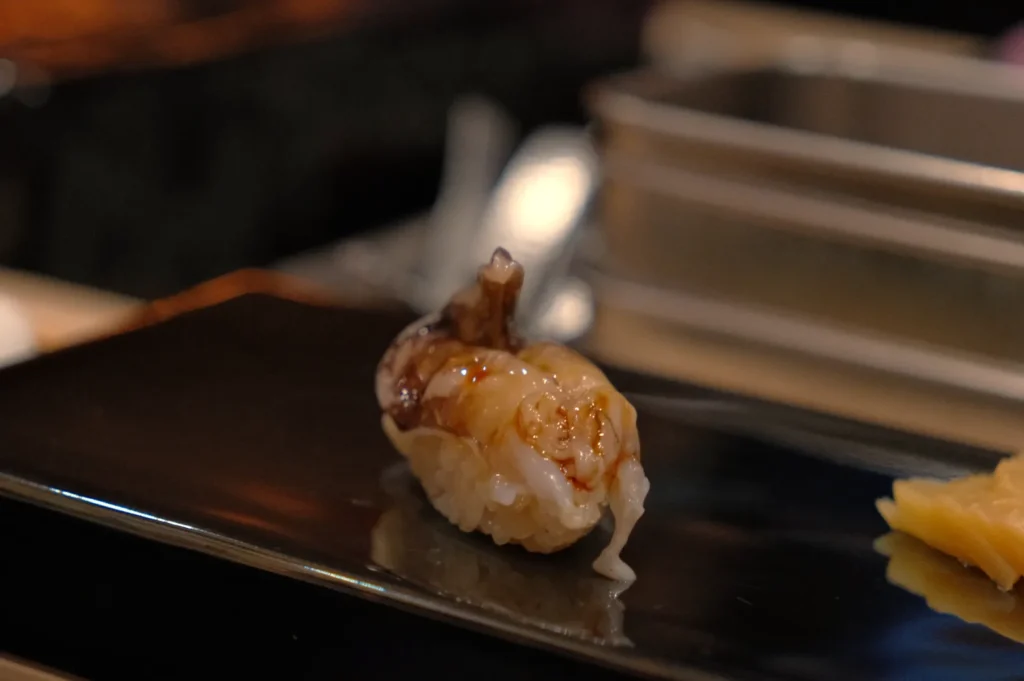
Here is where it becomes remarkable.
When you combine a glutamate-rich food with an inosinate-rich food in roughly a 1:1 ratio, the perceived umami does not simply add up. It multiplies. Studies point to an amplification of seven to eight times what either compound offers alone.
That is umami synergy pairing at work. Not one plus one. Closer to one times eight.
Now, the question that matters at the counter: where do these two keys come from?
Sake: A Reservoir of Glutamate
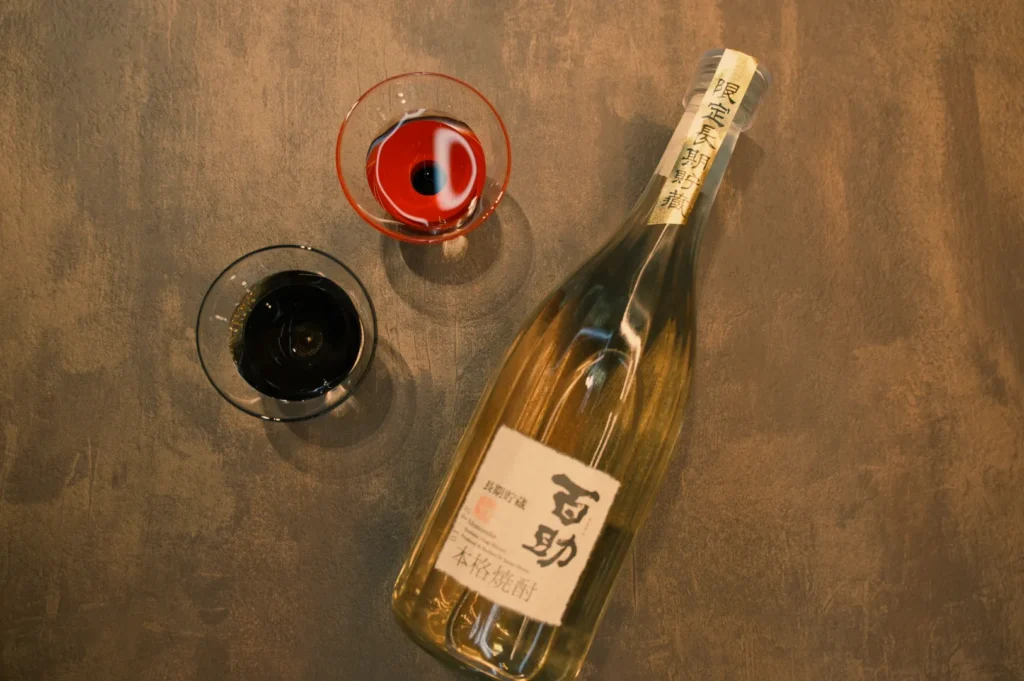
Sake carries an unusual amount of free glutamate. Research suggests it holds 10 to 20 times more than wine, beer, or spirits. Junmai styles typically contain between 100 and 250 mg of free glutamate per 100 mL.
Why so much? The answer lies in the brewing.
During koji fermentation, the mould Aspergillus oryzae releases enzymes, among them leucine aminopeptidase II (LAP II), that break rice proteins down into amino acids. Glutamate is one result. These sake amino acids are not added. They emerge, slowly, from the grain itself.
If you’d like a fuller picture of how the grain becomes the glass, our guide to understanding Japanese sake traces the craft from rice to cup.
Seafood: A Source of Inosinate
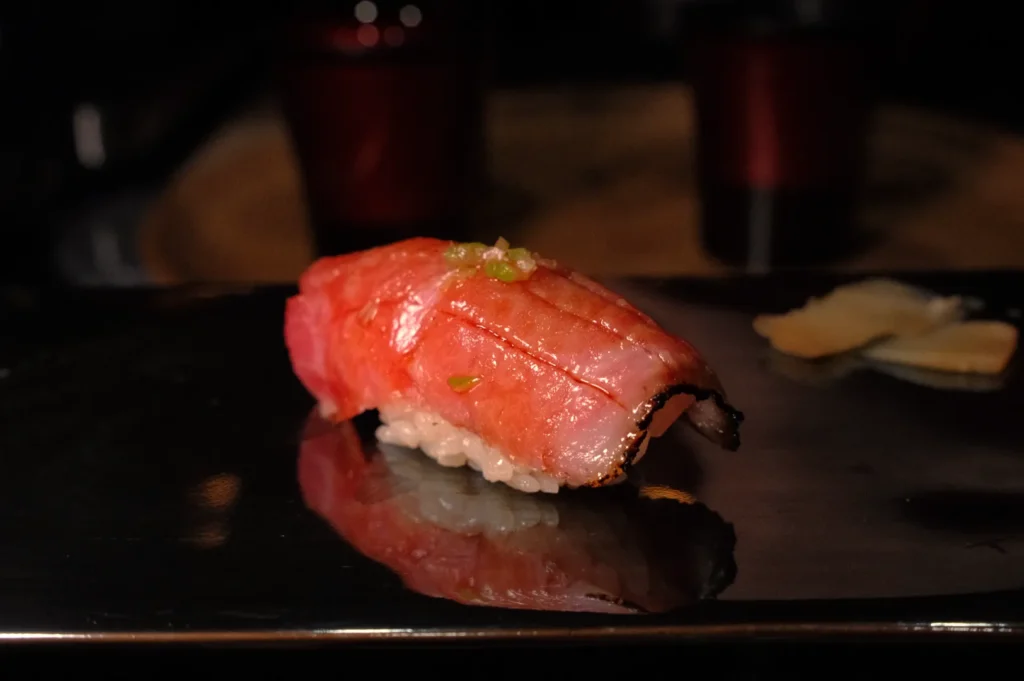
The sea holds the other key.
Fish is rich in inosinic acid. The numbers vary by species, but the pattern is clear:
- Tuna: 250–360 mg inosinate per 100g
- Yellowtail: 230–290 mg per 100g
- Sea bream: 180–300 mg per 100g
Glutamate in the glass. Inosinate on the plate. The two keys, waiting.
What Happens at the Counter
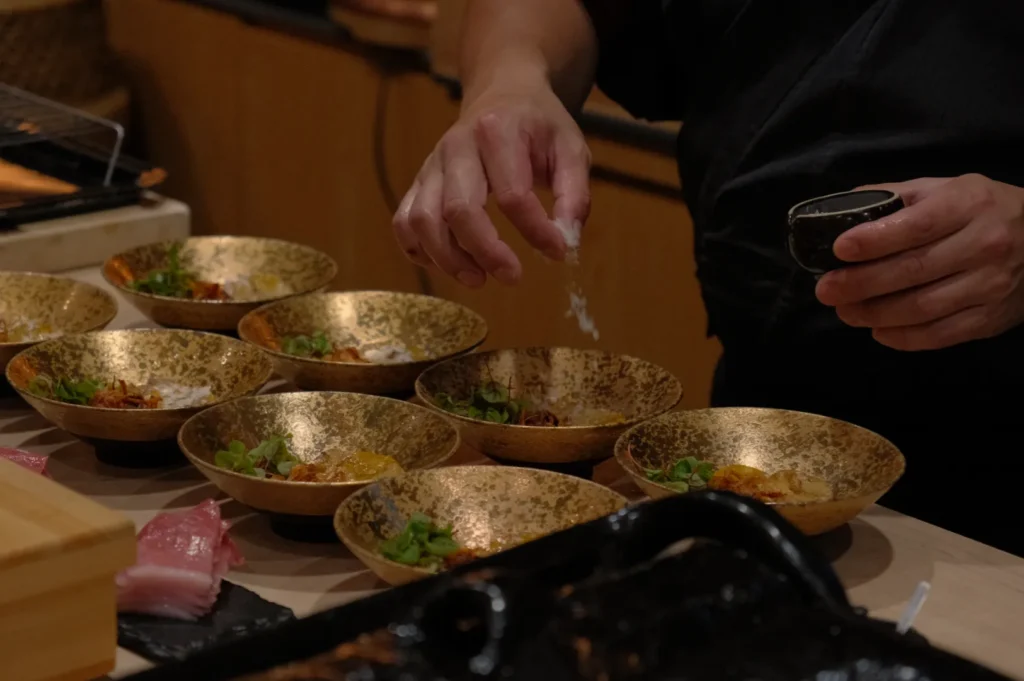
Now return to that first bite.
The tuna delivers inosinate. The sake delivers glutamate. When you sip between bites, both reach the T1R1/T1R3 receptor at once. Together, they hold the signal. Together, they deepen it.
This is why umami sake seafood pairings feel so complete. The effect is not merely additive. It is multiplicative: savoury depth that neither the fish nor the sake could reach alone.
For a closer look at how this plays out across a full omakase, our notes on sake pairing with seafood explore the practical side, dish by dish.
When More Is Not Better
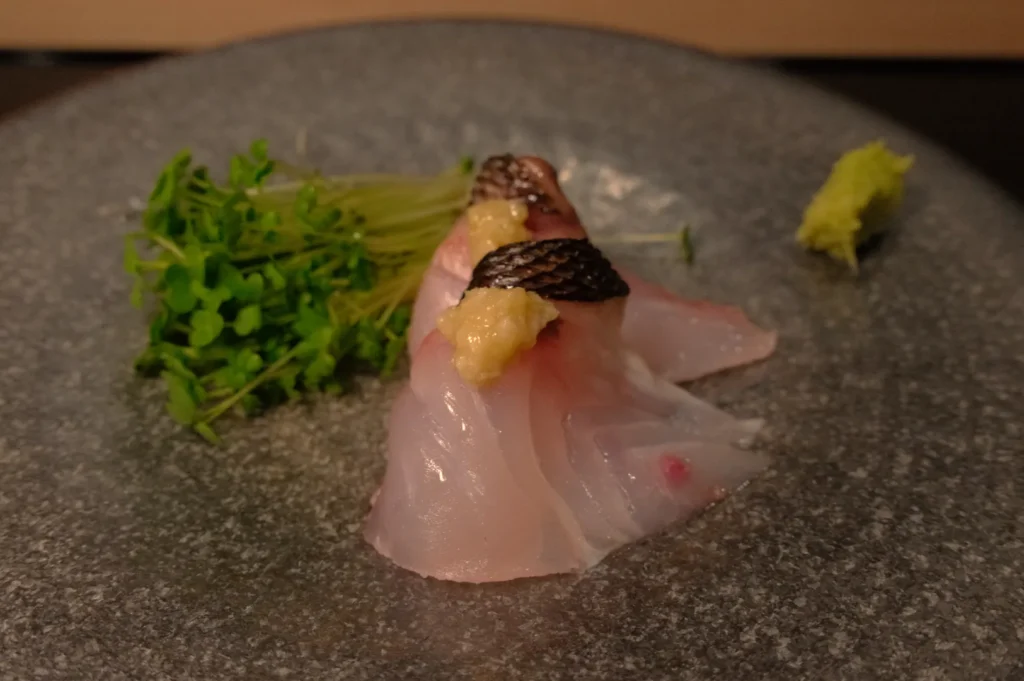
Yet balance matters. More umami is not always more pleasure.
Some seafood carries glutamate too, not only inosinate. Scallops hold around 140 mg per 100g. Clams, around 210 mg. Pair these glutamate-heavy ingredients with a sake already rich in amino acids, and both sides push in the same direction.
The result can fall flat. One-dimensional. Heavy where it should feel alive.
This is where restraint becomes craft. For high-umami seafood, a crisper, cleaner sake often serves better than a full-bodied, amino-acid-rich Kimoto or Yamahai. The lighter style leaves space. It lets the seafood umami content speak without crowding it.
Consider the total umami load: both sides of the pairing, not one alone.
A Mechanism, Not a Promise
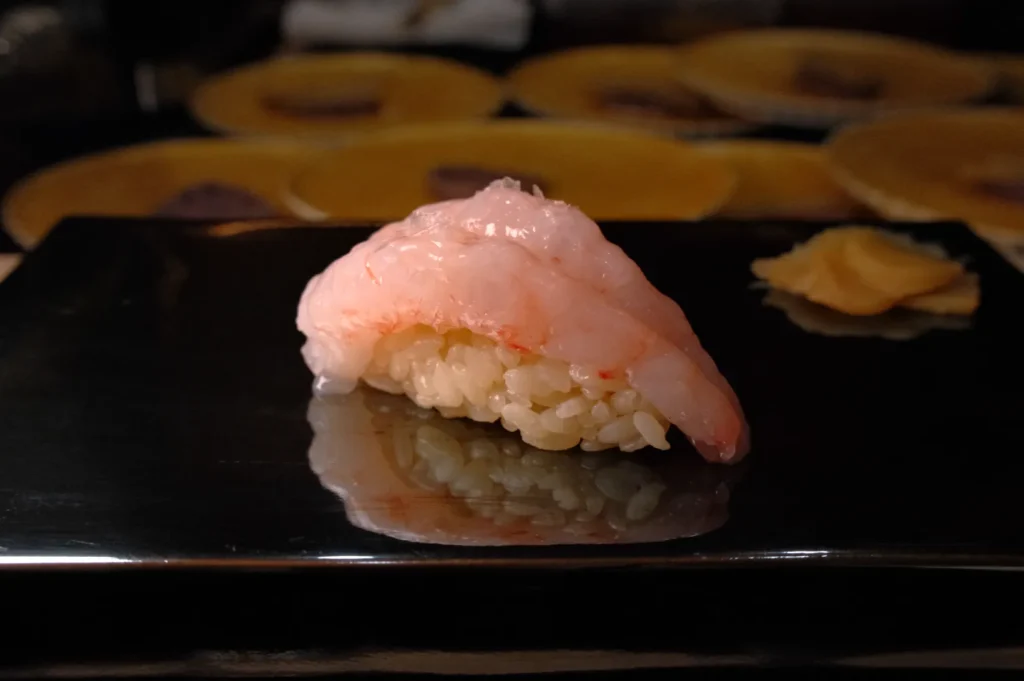
The science is verified. Glutamate and inosinate do amplify one another. Japanese cuisine umami has been built on this truth for over a century, long before anyone named the receptor.
But chemistry explains why a pairing works. It cannot promise that every sip and bite will move you.
Individual sensitivity varies. So does preparation: how the fish is aged, seasoned, or seared. Serving temperature shifts the experience. So does personal taste. Two people at the same counter, tasting the same pairing, may feel it differently.
Umami synergy is a mechanism. It is the reason behind the depth you notice when sake meets seafood. It is not a guarantee of delight, but an invitation to pay attention.
So next time you sit down, here at Cuppage Plaza, or anywhere the sea meets the glass, take the bite. Then the sip.
And notice what stirs in the pause between.